
EXCLUSIVE: A death in the afternoon
By Wade KwonI lost someone near and dear to me one year ago today. She and I had a nine-year relationship, and many knew her (if only by reputation) to be at times tough, dowdy, amusing, frustrating and downright forgettable.

No one will see her memorialized in the newspaper today, nor will they stop by her grave. She died a long and painful death, and her passing reminds us not only of the fragility of life but the certainty of death. And yet the city moves on, as indifferent to her in death as it was in life.
The Birmingham Post-Herald, May 15, 1950 – Sept. 23, 2005.
R.I.P.
Those who didn’t have the chance to read the Post-Herald may have read the Birmingham News instead. Those who read neither newspaper may keep tabs on local news through an alternative paper, or TV news.
And then we have those who don’t follow current events at all.
The strongest, most consistent, most in-depth journalism can still be found in our nation’s newspapers. They put in the resources and the investigative skills to tell the story of a community. I read the News regularly, though only online, to understand the issues that shape our city and state.
But like most cities, a single newspaper unchallenged by competition will never fully cover the diversity and complexity of stories out there. Local TV stations — with their own dogged competition and comparatively huge resources and profit margins — lack the airtime or the will to pursue longer, more complicated stories.
When I hear citizens complain about the poor quality of TV news, I ask them if they read the newspaper. Most say no.
Birmingham is like most medium and larger cities in America in its sole newspaper. In several cities, a media corporation will own both the only newspaper and one of the TV stations. Here, both the News and the Birmingham Business Journal are part of the Newhouse empire.
Media consolidation is becoming a bigger issue with each passing merger, buyout and shutdown. Those who believe that the current wide variety of channels and publications foster that healthy competition for news and information are in for a rude awakening — most news is coming from a handful of large, publicly traded companies.
That lack of media diversity is far worse at the local level. Suburban papers and alt weeklies can keep so-called big media in check, but only through a dogged pursuit of investigative journalism, an ongoing role as media watchdog and, of course, money and readership.
(And for the record, many blogs — including this one — rely heavily on mainstream media for information and analysis. To decry the local news outlets makes no more sense than to decry the Internet, high-speed connections and laptops themselves.)
Birmingham has supported a varying number of publications over the years, though the Post-Herald’s financial existence was more slight of hand than hard-won earnings. As contractual partners, the News and Post-Herald shared most resources (and expenses) and earned from the same pool of money.
The News, as senior partner, controlled most of these vital operations: advertising, circulation, marketing and more. No sane business would ever cede these powers to another, but no one said muckraking was a particularly cogent undertaking.
In the end, Newhouse bought the Post-Herald for $40.8 million from E.W. Scripps Co. Based on earnings reports, the Post-Herald was made $3 million in 2004, its last full year of operation, an 11.4 percent increase over 2003.
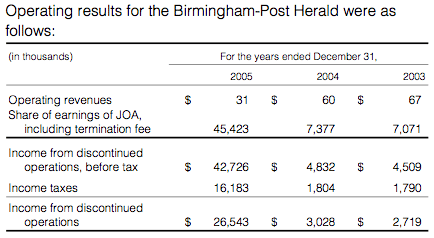
The Post-Herald — likely through the financial gains of the News, its joint-operating agreement partner — made more money in a supposedly slumping newspaper industry. Ironically, the News’ comparatively bigger gains helped it pay for the buyout/shutdown.
Even with this gain, it’s mighty difficult to run a news-gathering operation, already too lean from cutbacks and bean counting, of 50 or so employees on $3 million.
Checkmate.
A year later, the media market is mostly the same as it was years before. It remains up to citizens to keep tabs on current events, whether through local media or by their own devices. The survivors of the shutdown have moved away in droves, many to continue the struggle in newspapers across the country. Others have exited the news business altogether for new pursuits and industries or freelancing.
(I still write for a huge media company, and I still wear a suit and tie, just for fun.)
While the Post-Herald no longer influences city life, it continues to influence me and the surprising turns in my career. I came out alive, mostly unscathed and a better journalist to boot. Plus, I wouldn’t be talking directly to you today, as her passing led to the creation of this news site.
In life, few found the Birmingham Post-Herald necessary — if they found her at all. In death, she remains but a humble chapter in the city’s colorful history.
And one year after her death, she is remembered, if not missed.


Saturday, September 23, 2006, 7:27 pm
1990 or 1890?
Saturday, September 23, 2006, 9:14 pm
1950. I must’ve been overcome with grief.
Monday, October 2, 2006, 5:19 pm
I’m a former newspaper reporter and editor and can’t honestly say I ever really liked the Post Herald when compared to the News. But you’re right, people don’t read the paper anymore, because they want quick soundbites off network news, or they read the news on the internet. Not so for me because the morning begins with my newspaper no matter what, and I savor every word of it. Over the last few months, though, the News customer service has become shoddy; sometimes I get my paper, sometimes I don’t. I don’t want to be one of those soundbite people, but the News is trying to drive me to it. Lets hope we won’t be mourning the passing of the Birmingham News in a couple of years.